


By Solar Africa On 14-11-2026 at 3:00 pm
Off-Grid Solar Kit for Rural Homes in Kenya: Sizing Guide
If your home has no KPLC connection, or the connection is so weak or costly that you barely use it, solar is no longer a luxury. But the difference between a kit that lasts years and one that fails after two rainy seasons is rarely the brand of panel. It is sizing. Too many homes buy a panel and a battery with no idea what they need, then blame solar when the fridge stops running at night.
This guide shows you how to work it out on paper first. You can follow every step without buying anything from us.
Start with what you actually use
Forget panel watts for now. The number that matters is your daily load in watt-hours (Wh). That is simply an appliance's wattage multiplied by the hours you run it. Estimate each appliance honestly:
- LED bulbs: about 5–10W each, 4–6 hours a night.
- Phone charging: roughly 5–10Wh per phone per day.
- TV: a small LED set draws about 40–70W, run maybe 4 hours.
- Fridge: a small efficient fridge draws around 60–120W but only runs part of the day. Assume 8–12 hours of running equivalent for a hot rural area.
- Water pump: pumping is the heavy load. A 250W pump run for two hours is 500Wh.
Add everything up, then add 20–30% as a rainy-season and future-expansion margin. That total is your target.
What you need
Before spending anything, gather these facts:
- Your daily load in Wh (calculated above).
- Your peak simultaneous load in watts — fridge plus lights plus TV on at once.
- Whether your water source is shallow enough for a DC pump, and its lift in metres.
- Where the panels will go: unshaded, facing north, and safe from theft.
- A battery budget. The battery is the part people under-spend on.
Matching panels to Kenyan sun
Most of Kenya gets an average of about 4.5 to 5.5 peak sun hours a day, less in the long rains and on cloudy highland days. To size panels, divide your daily Wh by about 4 (a conservative figure that builds in rainy-season losses). So a 1,500Wh daily load needs roughly 375W of panel. If you plan to expand, buy the bigger panel now rather than replacing it later.
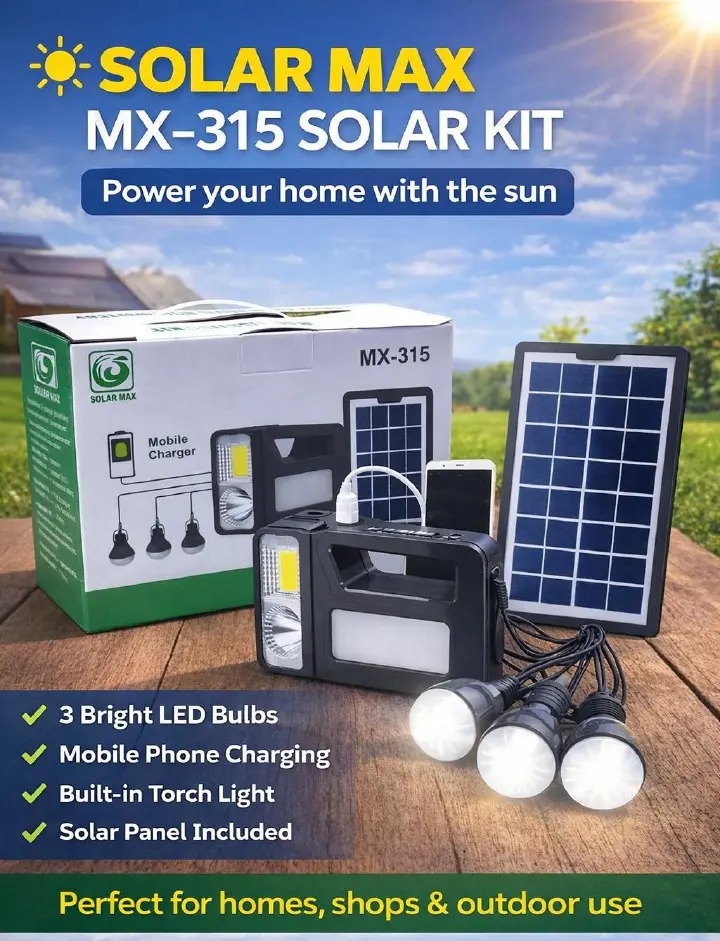
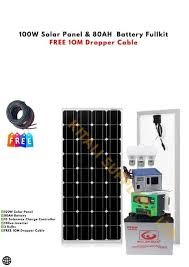
For a basic lighting-first home, a compact kit gets you started. The 100W Solar Home Lighting Kit pairs a 100W panel with an 80Ah battery, a 150VA inverter, a 10A controller and three LED bulbs — enough for lights and phone charging, not a fridge. For a purely lighting setup in a very small home or shop, the Solarmax MX-315 Solar Kit is a plug-and-play lighting kit with panel, power unit and three bulbs.
The battery bank matters more than panel count
Panels only make power while the sun shines. The battery carries you through the night and the grey days. A common mistake is buying three panels and one tired car battery: the panels are fine, but the storage cannot deliver.
To size batteries, take your nightly Wh and divide by the battery voltage (usually 12V), then by how deeply you are willing to discharge. Lead-acid batteries should not go below about 50%, so a 100Ah 12V battery gives you roughly 600Wh of usable energy. Lithium can be discharged much deeper and lasts far longer, which is why it often works out cheaper over the years. A deep-cycle option like the 100ah solarmax battery suits a modest lead-acid setup, while the Solarmax 12.8V 100Ah Lithium LiFePO4 Solar Battery is a 12.8V 100Ah LiFePO4 battery with deep discharge capability for a longer-lived bank.
Sizing the inverter
The inverter must cover your peak simultaneous watts, with headroom for motor start-up surges. A fridge compressor can briefly pull several times its running wattage. Add up the appliances you might run at once and leave at least 30–50% margin.
| Daily load (Wh) | Suggested panel (approx.) | Battery guideline | Typical use |
|---|---|---|---|
| Up to 300 | 100W | 80–100Ah, 12V | Lights, phones, radio |
| 500–900 | 200–300W | 100–200Ah, 12V | Lights, TV, phone charging |
| 1,200–2,000 | 400–600W | 200Ah+ or lithium | Adds a small fridge |
| 2,500+ | 800W+ | Larger bank, 24V preferred | Fridge, pump and full home |
For a small home running lights, a TV and charging, a 300W pure sine wave unit such as the Pure Sine Wave 300W Power Inverter covers sensitive electronics with overload, short-circuit and low-voltage protection. Bigger homes with fridges should move up to a 1kVA or larger pure sine wave inverter and, ideally, a 24V system.
Pump water directly from the panels
Water pumping is where off-grid homes waste the most power. Running a pump through the house inverter drains the battery and forces you to buy a bigger inverter. A DC solar pump instead runs directly from its own panels during the day, filling a tank. You then use gravity or a small pressure pump for the house. This keeps the pump off your battery entirely and is far cheaper to run.
A solar submersible pump with a 50-metre head, such as the 50M Head Solar Submersible Water Pump, is designed for boreholes, wells and livestock watering. Match the pump's lift to your actual water depth plus the height of your tank, and pump into storage during sunny hours rather than on demand.
Common mistakes
- Buying panels before calculating the load.
- Under-sizing the battery and over-discharging it nightly.
- Running a big pump through a small inverter.
- Mounting panels in shade or where trees will grow over them.
- No surge protection on the DC side and no fuses between battery and inverter.
- Forgetting that every added appliance changes the maths.
Maintenance and safety
Dust is the quiet killer in rural Kenya. Clean panels every week or two in the dry season with plain water and a soft cloth; dusty panels can lose a noticeable share of their output. Keep the battery in a ventilated, shaded place and check terminals for corrosion. Use thick, correctly rated cable and fuses; a shorted battery can cause a fire. Never run mains-style wiring from an inverter without proper earthing and a qualified fundi.
Keep a simple log of what you run and when the battery feels weak. It will tell you when it is time to expand storage rather than add more panels.
Frequently asked questions
How many solar panels do I need for a rural home in Kenya?
Divide your daily load in watt-hours by about 4 sun hours and add a 20–30% margin. A home using 1,500Wh a day needs roughly 375W of panels, while lights and phone charging alone may need only 100W.
Is lithium or lead-acid better for an off-grid solar kit?
Lithium LiFePO4 can be discharged much deeper and usually lasts longer, so it often costs less over the years. Lead-acid is cheaper upfront but should not go below about 50% depth of discharge.
Can I run a water pump from my house inverter?
It is possible but wasteful, because pumps are heavy loads that drain the battery and force a bigger inverter. A DC solar pump running directly from its own panels into a tank is more reliable and cheaper to run.
Products in this guide
- 100W Solar Home Lighting Kit
- Solarmax MX-315 Solar Kit
- 100ah solarmax battery
- Solarmax 12.8V 100Ah Lithium LiFePO4 Solar Battery
Prices and stock change often; open each product for today's price.

Author
Solar Africa
Related posts