


By Solar Africa On 14-11-2026 at 3:19 pm
Off-Grid Solar in Kenya: The Complete Guide
If you are tired of KPLC bills, outages or a grid that never reaches your land, this guide is for you. It is written for Kenyan homeowners, farmers and small business owners who are thinking about going fully off-grid with solar—disconnecting from the grid entirely or building a home or shop that never needs it.
Going off-grid is a big decision, and most advice online is either too technical or too salesy. This guide walks you through it step by step: how an off-grid system works, whether it suits your lifestyle and location, how to size it with a real worked example, how to choose panels, inverter and batteries, and how to install, budget and maintain everything safely.
By the end, you will be able to judge whether full off-grid makes sense for you, draft a realistic energy audit, understand what a fair quote looks like, and know the common mistakes to avoid. No product pitches—just clear, practical guidance to help you make an informed choice.
How a Fully Off-Grid Solar System Works
A fully off-grid solar system has no KPLC connection at all. It makes, stores and delivers its own electricity. Think of it as four parts working in a loop: the panels collect, the controller or hybrid inverter manages, the battery bank stores, and your appliances (the loads) use.
Step 1: The panels collect sunlight
Solar panels on your roof or ground mount turn sunlight into direct current (DC). Output rises and falls with the sun: strongest around midday, nothing after dark. A typical panel might be rated 300W to 550W, but real output is usually lower because of heat, dust and passing clouds.
Step 2: The controller or inverter manages the flow
A charge controller (or the controller built into a hybrid inverter) sits between panels and battery. It stops overcharging, prevents the battery draining back into the panels at night, and sends DC to your appliances either directly or through the inverter, which converts it to 220–240V AC for normal household plugs.
Step 3: The battery bank stores energy
Batteries carry you through the night and cloudy spells. Sizing is simple arithmetic. If your evening and night load is about 1kWh and you want two days of backup without sun, you need roughly 2kWh of usable storage, plus a margin because you should not drain most batteries flat.
Step 4: The loads use the power
Your lights, phone chargers, TV, fridge or water pump draw from the battery via the inverter. Big heating loads such as kettles, irons and cookers are heavy drinkers, so off-grid homes usually run these on gas or skip them.
At night and on cloudy days, the panels produce little or nothing, so everything runs on stored battery power. On a grey day a panel might give a quarter of its rated output, which is why real off-grid systems are sized with spare panel capacity and several days of autonomy.
Is Going Fully Off-Grid Right for You in Kenya?
Going fully off-grid means your home or business never draws a single unit from KPLC. Before you commit, weigh three honest questions.
1. Can you live with load discipline?
An off-grid system is a closed loop. Every kettle boiled, iron run or pump started comes out of your battery bank. Typical Kenyan homes use most power in the evening, when panels are idle, so you shift heavy chores to sunny hours. If someone leaves an iron on at 8pm, the inverter may shut down. Ask whether everyone in the house will follow this.
2. Do you have sun and space?
Kenya averages roughly 4 to 6 peak sun hours a day, but a shaded town plot or a rental roof can fall short. A 3kW array needs roughly 20 to 25m² of shade-free roof or ground, plus room for batteries and an inverter. If space is tight, partial off-grid (solar plus KPLC backup) is often wiser.
3. What does independence cost?
Worked example: a home using 6kWh a day saves about KES 1,500 a month on bills. A competent off-grid system may cost KES 250,000–400,000, so payback stretches many years. The real value is reliability for a farm, clinic or shop where an outage spoils stock or stops work.
Compare the options
| Option | Best for |
|---|
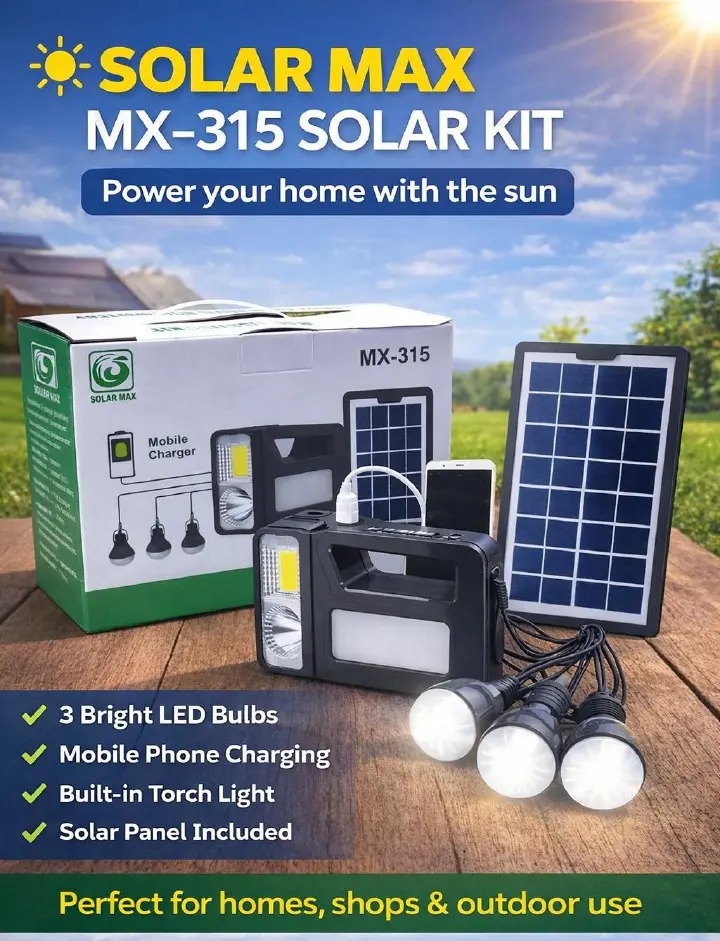
Full independence suits disciplined users with good sun and genuine need. Otherwise, start small — even a basic lighting kit such as the Solarmax MX-315 Solar Kit can cut evening dependence before you scale up.
Sizing Your Off-Grid System: A Worked Example
Sizing starts with knowing how much power you actually use. Do this before you buy anything. An energy audit simply means listing every appliance, how many watts it draws (its wattage is usually printed on a label) and how many hours a day you use it.
Step 1: Add up your daily load
Take a typical Kenyan home: 8 LED bulbs at 10W for 5 hours, one 32" TV at 60W for 4 hours, a WiFi router at 10W for 24 hours, phone chargers at 20W for 3 hours and a small fan at 40W for 4 hours.
| Load | Watt-hours per day |
|---|---|
| 8 bulbs (80W × 5h) | 400 |
| TV (60W × 4h) | 240 |
| Router (10W × 24h) | 240 |
| Chargers (20W × 3h) | 60 |
| Fan (40W × 4h) | 160 |
| Total | 1,100 Wh ≈ 1.1 kWh |
Step 2: Decide how many cloudy days to cover
Battery sizing uses "days of autonomy" — how long the bank runs your load with little sun. In most of Kenya, typical sun hours are around 4–5 a day, but clouds happen. Allow 2 days for a home like this: 1.1 kWh × 2 = 2.2 kWh of usable storage. Batteries should not be drained flat, so assume only about half of a lead-acid bank is usable. That means roughly 4.4 kWh of battery capacity, or four 12V 100Ah batteries.
Step 3: Size the panels
Divide daily use by typical sun hours: 1,100 Wh ÷ 4.5 ≈ 245W. Add about 30% for losses, giving roughly 320W. For a kit of this scale, the 3.3kW Advanced Solar Power System combines 3.3kW of panels with lithium batteries and a hybrid inverter — comfortably larger than this example and suited to adding a fridge later. Always round up, never down.
Choosing Your Off-Grid Kit, Inverter and Batteries
Once you know your daily energy need from sizing, the next job is matching three things: the inverter, the solar controller (often built into a hybrid inverter) and the battery bank. They must fit each other and your load, without being oversized (wasted money) or undersized (constant tripping and short battery life).
Step 1: Match the inverter to your biggest load
Add up the wattages of appliances you may run at the same time, then allow a margin for starting surges. A fridge or pump can draw two to three times its running watts for a few seconds. A 300W inverter will comfortably run lights, a router and a small fan, but not a pump or iron. The Pure Sine Wave 300W Power Inverter is a pure sine wave 300W unit, so it suits sensitive electronics and lighting. For a bigger household, look for a hybrid inverter rated above your total load and able to accept your planned panel and battery voltages.
Step 2: Match the controller to the panels
The controller’s voltage and current ratings must exceed the panel array. If you plan about 1,000W of panels on a 24V battery, the controller needs to handle roughly 40A or more. Check the datasheet before buying.
Step 3: Size the battery bank
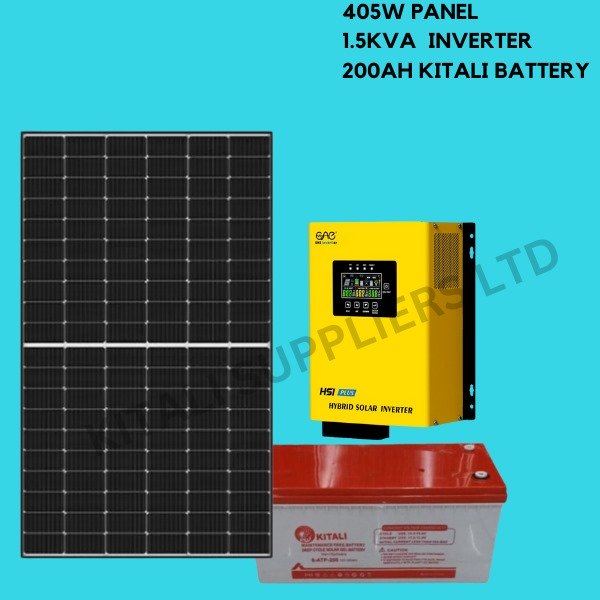
Multiply your daily need in kWh by your days of autonomy, then divide by usable depth of discharge. For example, 5kWh daily with two cloudy days and 80% usable lithium gives 5 × 3 ÷ 0.8 = about 18.75kWh of storage. A ready-made example is the 3.3kW Advanced Solar Power System, which pairs 6 × 550W panels, two 200Ah lithium batteries and a 3kVA hybrid inverter.
| Check | Rule |
|---|---|
| Inverter | Rated above peak load, with surge margin |
| Controller | Voltage and amps above panel array |
| Battery | Daily kWh × autonomy ÷ usable depth |
Choosing and Mounting Your Solar Panels
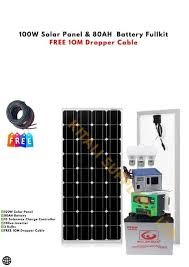
Panels are the part of your system that actually earns money, so choose and place them once, carefully. Most Kenyan off-grid homes use monocrystalline panels, which give the most power per square metre and are the easiest to mount. Polycrystalline panels cost a little less but take up more roof space for the same wattage, so they suit ground mounts where space is not tight. Avoid small toy-sized panels unless you are only running lights.
Step 1: Work out how many panels you need
Divide your daily energy need by the sun hours you expect. In most of Kenya you can plan on roughly 4 to 5 good peak sun hours a day, less in the cool highland wet season. If your home needs about 6 kWh a day, that is 6000 Wh ÷ 4.5 hours ≈ 1,330W of panels, and you then add 20–30% for losses and cloudy days. Six 550W panels give 3.3kW, comfortably more than that example needs.
Step 2: Check the space you have
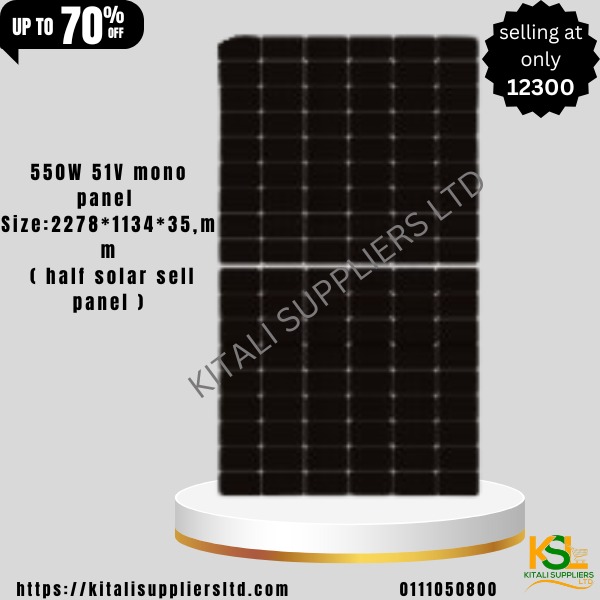
- A 550W panel is roughly 2.3m × 1.1m, so allow about 2.5m² each including gaps.
- Six panels need around 15m² of clear roof or ground.
- Measure with a tape before buying, and keep panels away from water tanks, aerials and tall trees.
Step 3: Tilt and point them correctly
Kenya sits on the equator, so a gentle tilt of about 10 to 15 degrees facing north or south works well; the aim is mainly to let rain wash off dust. Face the panels towards the midday sun and keep shade off them from 9am to 3pm.
Step 4: Mount safely
Use aluminium rails fixed to the roof structure, never just to the iron sheets, and leave a gap under the panels for air to pass. On the ground, build firm posts about 0.5m high to keep panels clear of livestock, mud and theft.
Installation and Wiring Basics
Off-grid wiring is simple in principle but unforgiving of shortcuts. A 3.3kW array and a battery bank can deliver dangerous currents, so every cable, fuse and earth point must be right.
Professional or DIY?
A small lighting kit you can mount yourself. Anything with a battery bank, inverter and multiple circuits should be wired by a qualified electrician or licensed solar technician (EPRA-licensed in Kenya). Budget for labour in your plan, and ask the installer to show you the finished wiring and label every breaker.
Size cables for current and distance
Voltage drop wastes power and overheats cables. Use thick DC cable between panels, controller and battery, and thinner AC cable after the inverter.
| Cable run | Typical size |
|---|---|
| Panels to controller | 4–6mm² DC |
| Controller/battery to inverter | 16–25mm² DC |
| Inverter to sockets | 2.5mm² AC |
Worked example: a 3kVA inverter at 24V draws roughly 125A, so it needs short, thick battery cables.
Fuses, breakers and earthing
- Fuse or breaker on every panel string and on the battery positive.
- DC breakers rated for DC, not AC.
- Earth the inverter casing, panel frames and battery rack to a rod.
Battery placement and ventilation
Put batteries on a dry, level, shaded rack, away from children and heat, with airflow. Lead-acid types need a vented room; lithium tolerates indoor placement but still needs space to cool.
Safe wiring order
Install mounting and earth first. Connect the battery to the controller, then panels to the controller, then the inverter to the battery. Switch off all breakers before connecting, and connect the inverter last.
Costs, Budget and Payback for Off-Grid Solar in Kenya
An off-grid system is a big spend up front that then pays you back slowly. Instead of a monthly KPLC bill, you pay once for equipment and installation, then a small amount for upkeep. Below is how the money usually breaks down for a typical Kenyan home.
What you are paying for
- Panels: usually the cheapest part per watt. Expect roughly a fifth to a quarter of the total.
- Batteries: the most expensive item, often 35–45% of the budget. Lithium costs more than lead-acid but lasts longer.
- Inverter and charge controller: around 15–20%, more if you want 240V appliances.
- Mounting, cables, fuses, breakers and earthing: about 10%.
- Labour and installation: roughly 10–15%.
A worked example
Take a home using an average of about 6 kWh a day. A system of roughly 2 kW of panels, a 3kVA hybrid inverter and around 5–10 kWh of battery storage might cost in the region of KSh 350,000–600,000 installed, depending on battery type and how much you buy locally.
If that home was paying about KSh 7,000 a month to KPLC, that is KSh 84,000 a year. A generator user burning fuel for several hours daily could easily spend more.
Realistic payback
Divide the system cost by your yearly saving. At KSh 500,000 and KSh 84,000 a year, payback is about six years. Add battery replacement after 5–10 years and treat the figure as a guide, not a promise. Cutting heavy loads first shortens payback fastest.
Maintenance to Keep Your Off-Grid System Running for Years
An off-grid system rewards a little regular attention. None of these jobs is technical, and together they take perhaps an hour a month. Skipping them is the most common reason panels underperform and batteries die early.
Clean the panels
Dust, bird droppings and soot cut output quietly. In dusty or dry-season areas, rinse panels with clean water and a soft cloth early morning or late evening when they are cool. Never scrub dry or use abrasives. A dirty panel can lose roughly 10–20% of its output; on a 3.3kW array that is around 0.3–0.6kW missing on a good day.
Check the batteries
Look at them monthly. For sealed types, check terminals are tight and free of white corrosion (clean with a little bicarbonate of soda and water, then dry). For flooded lead-acid, top up with distilled water to the marked level only, and never above it. Lithium batteries need little beyond keeping them cool and dry. Whatever your battery, keep it in a ventilated space away from direct sun.
Inspect connections and the inverter
- Feel cable joints and terminals for looseness or heat when the system is working on a sunny day; a warm joint needs tightening.
- Look for frayed insulation or rodent damage on exposed cable runs.
- Check the inverter and charge controller: fans should spin freely, vents dust-free, and no error lights or beeping. Record any fault code before resetting.
Seasonal checks
Before the long rains, confirm the mounting frame is tight and the roof has no leaks, and trim branches that shade the array. After heavy rain, inspect for water in junction boxes. In the hot dry months, check battery temperature; heat shortens battery life more than anything else. A simple logbook of monthly readings will show a fading battery long before it fails.
Safety, Common Mistakes and What to Avoid
Off-grid solar rewards careful work. Most failures we hear about in Kenya are not faulty panels or bad luck — they are simple, avoidable mistakes. Here are the big ones and how to dodge them.
1. Undersizing the battery bank
People size the battery for a sunny day and forget cloudy ones. If your household uses about 5 kWh a day and you want two days of backup, you need roughly 10 kWh of usable storage. With lead-acid, never plan to use more than half its capacity, so you would need about 20 kWh of labelled storage. Too small a bank means deep discharges every night, and deep cycling shortens battery life fast.
2. Mixing old and new batteries
Never add a new battery to an old bank, or join batteries of different age, brand or capacity. The weak one drags the whole bank down, and the strong one cooks trying to charge it. Replace the whole bank together, and keep every battery the same model.
3. Poor earthing and weak connections
Earth the panel frames, inverter casing and battery negative to a proper earth rod. Loose terminals are a fire risk: a slightly loose bolt can heat up under load. Check every connection with a spanner and torque where the manual says so. Fuse the positive battery cable close to the battery.
4. Unventilated battery rooms
Lead-acid batteries release hydrogen gas while charging, which can explode near a spark. Keep them in a ventilated space, never in a sealed cupboard or a bedroom, and keep flames and switches away. Lithium batteries do not vent gas in normal use but still need cool, dry airflow.
5. Other safety rules
- Switch off the panels and battery before touching wiring.
- Cover panels with a cloth while working on the array.
- Keep children away from batteries and exposed cables.
- Never run heavy heating appliances — irons, kettles, microwaves — on a small inverter; they overload it and can start a fire.
Frequently asked questions
Can I go fully off-grid with solar in Kenya without a KPLC connection at all?
Yes. Many rural homes and farms in Kenya operate entirely off-grid with solar, batteries and an inverter, with no KPLC meter. You just need a system sized to cover your daily energy use through cloudy spells.
Do I need a licence or approval to install off-grid solar in Kenya?
For a standalone off-grid system with no grid connection, no KPLC approval is required. However, if you later want to connect to the grid or use a hybrid system that exports power, you must follow KPLC and EPRA rules.
How many days of autonomy should I plan for in Kenya's climate?
Most Kenyan regions have good sun, but cloudy and rainy seasons can last two to three days. A common recommendation is two to three days of battery autonomy for essential loads, depending on your location and budget.
Can I run a fridge, iron box or water pump on an off-grid solar system?
Yes, but high-power appliances like irons, kettles and pumps need an inverter and battery bank sized for their surge demands. It is often cheaper to use energy-efficient appliances or run heavy loads during peak sun hours.
What happens to my off-grid solar system when it rains for a week?
Panels still generate some power on cloudy days, but much less. A well-sized battery bank and sensible load discipline will carry you through, and a backup generator or grid charger can be added if long rainy spells are common in your area.
Products in this guide
Prices and stock change often; open each product for today's price.

Author
Solar Africa
Related posts