



By Solar Africa On 14-11-2026 at 5:49 pm
Solar Water Pumping for a Farm or Borehole in Kenya
If you depend on a borehole, well or river, fuel and grid power are the two costs that never stop. A solar pumping setup moves that cost to a one-off purchase and a little maintenance. This guide walks through sizing and building a system step by step, so you can plan sensibly even before you spend a shilling.
What you need
- A clear idea of your daily water demand in litres
- Borehole or well depth, and the water level when pumping
- Total lift (head) from water level to the highest tank or tap
- A pump matched to that head and flow
- Solar panels sized for the pump's watts
- Mounting frame, cable, and a float switch or controller
- A storage tank for evenings and cloudy days
- Basic tools and a plan for cleaning and inspection
Step 1: Estimate your daily water demand
Measure in litres per day, not “enough”. These are typical, approximate figures to start you off:
| Use | Typical daily need |
|---|---|
| Dairy cow | 60–100 litres |
| Cattle (beef) | 40–60 litres |
| Goat or sheep | 5–10 litres |
| Household (5 people) | 100–200 litres |
| Drip irrigation | Roughly 3–6 litres per plant per day, depending on crop and season |
Add everything, then add 20–30% for losses and hot days. A farm with 20 cattle and a family may need around 1,500–2,000 litres a day. A quarter-acre of drip-irrigated vegetables can easily double that.
Step 2: Work out the head
Head is the vertical distance the water must rise, measured from the water level in the borehole — not from the ground surface — to the highest point it discharges. Add about 10% for pipe friction on long runs. If the water level is 25 m down and your tank sits 5 m up, plan for about 33 m of head.
Also note the flow you need. If 2,000 litres must arrive in six effective sun hours, that is about 330 litres per hour — modest. Bigger demand means a bigger pump, not a bigger tank alone.
Step 3: Match the pump to the borehole
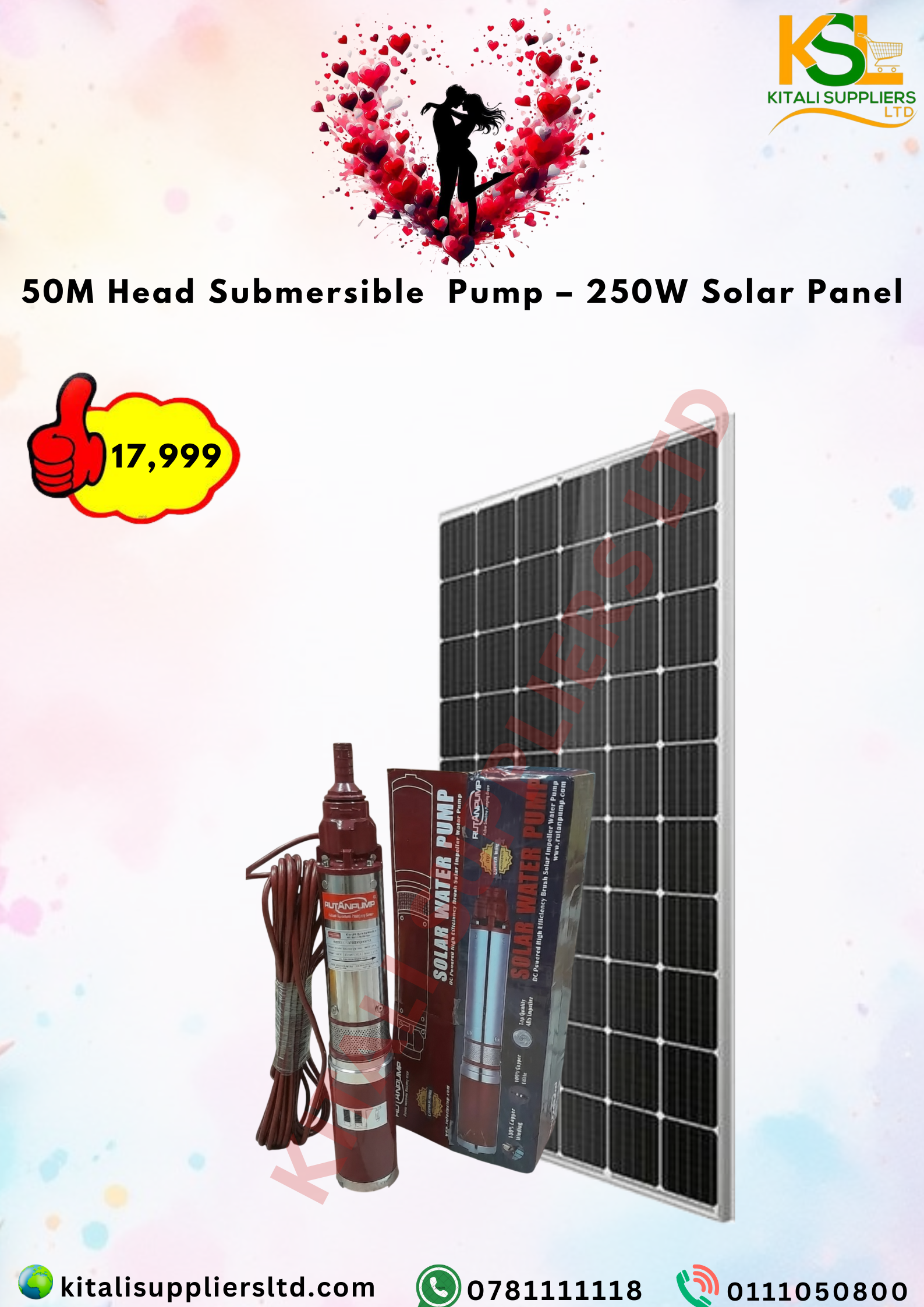
Choose a submersible pump whose maximum head comfortably exceeds your calculated head, and whose flow at that head suits your tank. The 50M Head Solar Submersible Water Pump is a borehole submersible pump rated to a 50 m maximum head with a 250 W panel — a sensible shape for a well or shallow borehole where total head stays well below 50 m. The Rutan Solar DC Submersible Pump System with 300W Solar Panel & Float offers a similar 50 m head with a 24V submersible pump and includes a float switch, which helps stop the pump running dry and fills a tank automatically.
Be honest about depth. If your water sits 60 m down, neither pump is the right answer. Look for a deeper-head pump or ask a borehole specialist; the need is real, but you should not force a shallow pump to do it.
Surface pumps suit shallow wells, rivers and tanks rather than deep boreholes. A fuel pump such as the 2″ Honda Water Pump Set can shift large volumes for irrigation but keeps costing you petrol every day — useful as a stopgap, not a solar substitute.
Step 4: Size the solar panels
Panels should match the pump's rating, with a little margin. A 250 W pump works well with 250–300 W of panels in good sun. Kenya typically gets four to six peak sun hours a day, more in dry months, less in cloudy highlands. Panels must face north (or nearly so) and be tilted to shed dust and rain.
If you are assembling a kit, a panel like the 270W Golden Solar Bifacial Solar Panel can serve as the main module, provided the total panel wattage meets the pump's requirement. Do not mix mismatched panels on one pump; wire them to the voltage the pump expects.
Step 5: Storage tank or battery backup?
For most farms, storage beats batteries. Water in a raised tank is cheaper than electricity in a battery and never wears out. Size the tank for one to two days of demand, so evening watering and a cloudy morning do not leave you dry. The float switch mentioned above makes filling automatic.
Batteries and inverters are worth it only when you must pump at night or need very steady pressure. Remember that a 300 W inverter will not start a pump that draws far more at startup — match the inverter to the pump, not the other way round. A booster such as the Pedrollo 1HP Booster Pump is handy for pushing stored water around a homestead or irrigation line, but it does not lift water from a borehole.
Step 6: Installation and mounting
- Use a proper frame; panels act like sails in wind
- Keep cable runs short and sized for the current to avoid voltage drop
- Hang the pump above the borehole floor, never buried in silt
- Fit a safety rope so the pump can be pulled for service
- Install the float switch or dry-run protection before first run
- Test flow into the tank on a sunny midday
Step 7: Running costs
Once installed, running costs are mainly cleaning and occasional replacement parts. No fuel, no monthly bill. That is the whole point: a system that pays for itself over a few seasons of pumping.
Common mistakes to avoid
- Sizing the pump from ground level instead of water level
- Under-sizing panels, then blaming the pump in cloudy weather
- No storage tank, so water only flows at midday
- Ignoring dry-run protection and burning out the pump
- Using a small inverter or generator that cannot handle startup current
Maintenance and safety
Clean panels weekly in dusty seasons. Check wiring and the float switch monthly. Inspect the tank for leaks and keep the cover on to stop algae. Never work on wiring while the sun is on the panels; isolate first. Keep children and livestock away from the panel frame and open tank. If you notice reduced flow, check the panels and filters before assuming the pump is finished.
Build the system around your measured demand and head, and it will serve you for years.
Frequently asked questions
How many solar panels do I need for a borehole pump in Kenya?
Match the panels to the pump's rating, usually 250–300 W of panels for a small submersible pump, plus a little margin for cloudy days. Deeper bores and higher flow need more panels.
Can a solar pump run at night?
Not directly from panels. Store water in a raised tank during the day, or use a battery and inverter sized to the pump's startup current.
How deep a borehole can a solar submersible pump handle?
It depends on the pump's rated maximum head. A 50 m head pump suits wells where total lift stays below that; deeper boreholes need a pump rated for the extra depth.
Products in this guide
- 50M Head Solar Submersible Water Pump
- Rutan Solar DC Submersible Pump System with 300W Solar Panel & Float
- 2″ Honda Water Pump Set
- 270W Golden Solar Bifacial Solar Panel
Prices and stock change often; open each product for today's price.

Author
Solar Africa


