


By Solar Africa On 16-11-2026 at 7:42 am
Battery Bank Design in Kenya: The Complete Guide
This guide is for Kenyan homeowners, farmers and small business owners who are building a battery bank from scratch or upgrading the one they already have. Whether you are running a single battery on a small inverter in a kiosk or planning a multi-battery off-grid bank for a farmhouse, the same principles decide whether your system serves you for years or fails within months.
The problem is that most buyers are sold a battery and an inverter without anyone checking the energy they actually need, the voltage that suits their loads, or whether their charger and panels can refill the bank each day. The result is deep discharges, cooked batteries, oversized bills and replacements far too soon, often with no clear explanation of what went wrong.
By the end of this guide you will be able to list your loads and work out your daily energy use, convert that into a bank size and voltage, understand series and parallel wiring, match the inverter, charger and solar panels to your bank, estimate real Kenyan costs and payback, and keep the bank healthy through routine maintenance. You will also know the common mistakes to avoid and how to check a quotation before you pay.
How a Solar Battery Bank Works: Volts, Amps, Watts and Depth of Discharge
A battery stores energy, and that energy is moved around in three simple measures: volts (pressure), amps (flow) and watts (actual power). Volts × amps = watts. A 12V battery delivering 10 amps is giving you 120 watts. Run that load for two hours and you have used 240 watt-hours (Wh) of energy — the real currency of a battery bank.
Battery capacity is quoted in amp-hours (Ah). A 100Ah, 12V battery holds roughly 100 × 12 = 1,200Wh. On the shelf it looks generous, but you can rarely use all of it.
Depth of discharge and usable capacity
Depth of discharge (DoD) is the share of a battery you draw before recharging. Discharge a lead-acid or gel battery to 50% and it lasts far longer than if you drain it flat every night. Lithium handles deeper discharges well, often down to 80–90%.
| Battery type | Typical safe DoD | Usable energy from a 100Ah 12V battery |
|---|---|---|
| Lead-acid / gel | About 50% | Around 600Wh |
| Lithium (LiFePO4) | About 80–90% | Around 960–1,080Wh |
So a 100Ah lead-acid battery is really only a 600Wh battery in daily use. That is why people often buy more battery than they first think they need.
Cycles: the battery's lifespan
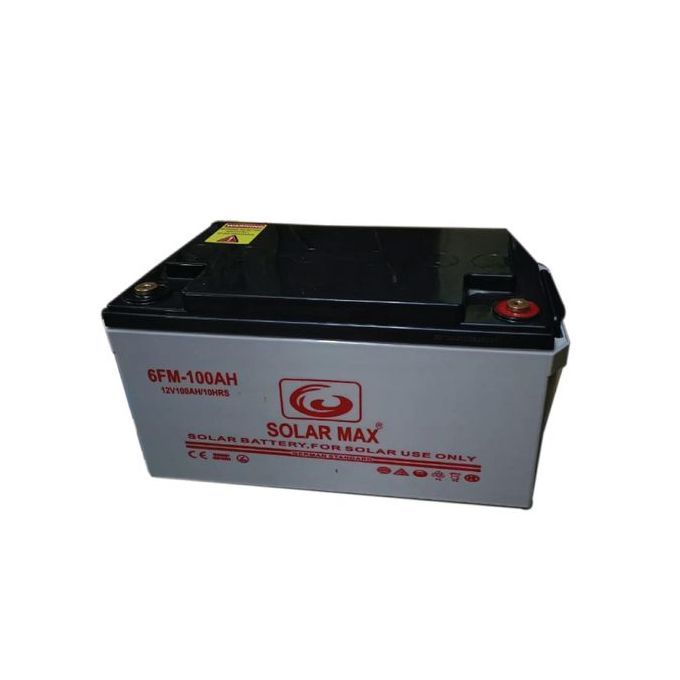
A cycle is one full charge and discharge. Shallow cycles give many more cycles than deep ones, so gentler use stretches life. A 100Ah deep cycle battery, such as the 100ah solarmax battery, is a familiar starting point for a small 12V bank, while a lithium option like the Solarmax 12.8V 100Ah Lithium LiFePO4 Solar Battery offers deeper usable capacity for the same quoted Ah.
Understand these four ideas — watts, watt-hours, DoD and cycles — and you can judge any battery quote yourself.
Planning and Sizing Your Battery Bank: A Worked Example for a Kenyan Home
Sizing is simply working out how much energy you use, then buying a bank that stores that much with room to spare. Skip it and you either overspend or find your lights die at 9pm. Here is the method, step by step, with real numbers.
Step 1: List your loads and their run time
Walk through the house and write down every appliance you want on the battery. For each, note its wattage (check the label or manual) and how many hours a day it runs.
| Load | Watts (typical) | Hours/day | Wh/day |
|---|---|---|---|
| 8 LED bulbs | 8 each = 64 | 5 | 320 |
| TV | 80 | 4 | 320 |
| Phone charging (2) | 10 | 4 | 40 |
| Fan | 50 | 6 | 300 |
| Fridge (small, efficient) | 100 | 8 running | 800 |
Total daily energy: about 1,780 watt-hours (Wh), or roughly 1.8kWh.
Step 2: Add inverter losses
An inverter is not perfect; expect to lose about 10–15%. Divide by 0.85. So 1,780 ÷ 0.85 ≈ 2,095Wh a day that the battery must actually deliver.
Step 3: Allow for cloudy days (autonomy)
In Kenya one cloudy day is normal. Multiply by 2: 2,095 × 2 ≈ 4,190Wh – the energy your bank must hold before depth of discharge.
Step 4: Allow for depth of discharge
Lead-acid batteries should not be drained below about 50%; lithium can go deeper. For lead-acid, divide by 0.5: 4,190 ÷ 0.5 ≈ 8,380Wh of nameplate capacity.
Step 5: Convert to amp-hours
Amp-hours = Wh ÷ bank volts. For a 12V bank: 8,380 ÷ 12 ≈ 700Ah. At 24V: about 350Ah. At 48V: about 175Ah. So a 24V bank of four 150Ah batteries, such as the 12V 150Ah/10Hr Deep Cycle Solar Battery, wired correctly, fits this example.
Write down your own list before you shop; it is the single most useful page you will take to a supplier.
Choosing the Right Battery Type and Capacity for Your Bank
Not all batteries are built for Kenyan heat and daily deep discharge. Here is how lead-acid, gel and lithium compare on the things that matter: cost per usable kWh, cycle life, heat tolerance and maintenance.
Compare cost per usable kWh
A 12V 100Ah lead-acid battery holds about 1.2kWh, but you should only use 50% (0.6kWh) to make it last. A 12V 100Ah lithium LiFePO4 battery can safely use about 80% (roughly 1kWh). So the lithium often works out cheaper per usable kWh over its life, even if the sticker price looks higher. For example, the Solarmax 12.8V 100Ah Lithium LiFePO4 Solar Battery offers 12.8V and 100Ah in lithium, while the 100ah solarmax battery is a 100Ah deep-cycle lead-acid.
Cycle life and heat tolerance
Lead-acid typically gives 300–500 cycles at 50% depth, gel a little more, and lithium LiFePO4 often 2000–5000 cycles at 80% depth. Kenyan heat shortens lead-acid life more sharply, so keep any battery bank cool and ventilated.
Maintenance needs
Flooded lead-acid needs water checks; gel and lithium are maintenance-free. Lithium also charges faster and weighs less.
Read the label properly
Look for the 20-hour (20Hr) capacity rating – that is the number you should use for sizing. A “100Ah” battery rated at 20Hr delivers 5A for 20 hours. Also check the voltage (12V nominal) and the cycle life at a stated depth of discharge. Avoid vague “100Ah” claims without a rating.
| Type | Usable depth | Typical cycles | Heat tolerance | Maintenance |
|---|---|---|---|---|
| Lead-acid | 50% | 300–500 | Moderate | Water checks |
| Gel | 50–60% | 500–800 | Good | None |
| Lithium LiFePO4 | 80–90% | 2000–5000 | Good with cooling | None |
Pick the type that fits your budget and maintenance habits, then size the bank using the usable capacity, not the label headline.
Choosing the Inverter, Charger and Solar Panels to Match Your Bank
Your batteries are only half the system. The inverter, charge controller and panels must speak the same language as your bank, or you will either starve it or cook it.
Step 1: Let the bank voltage pick your inverter
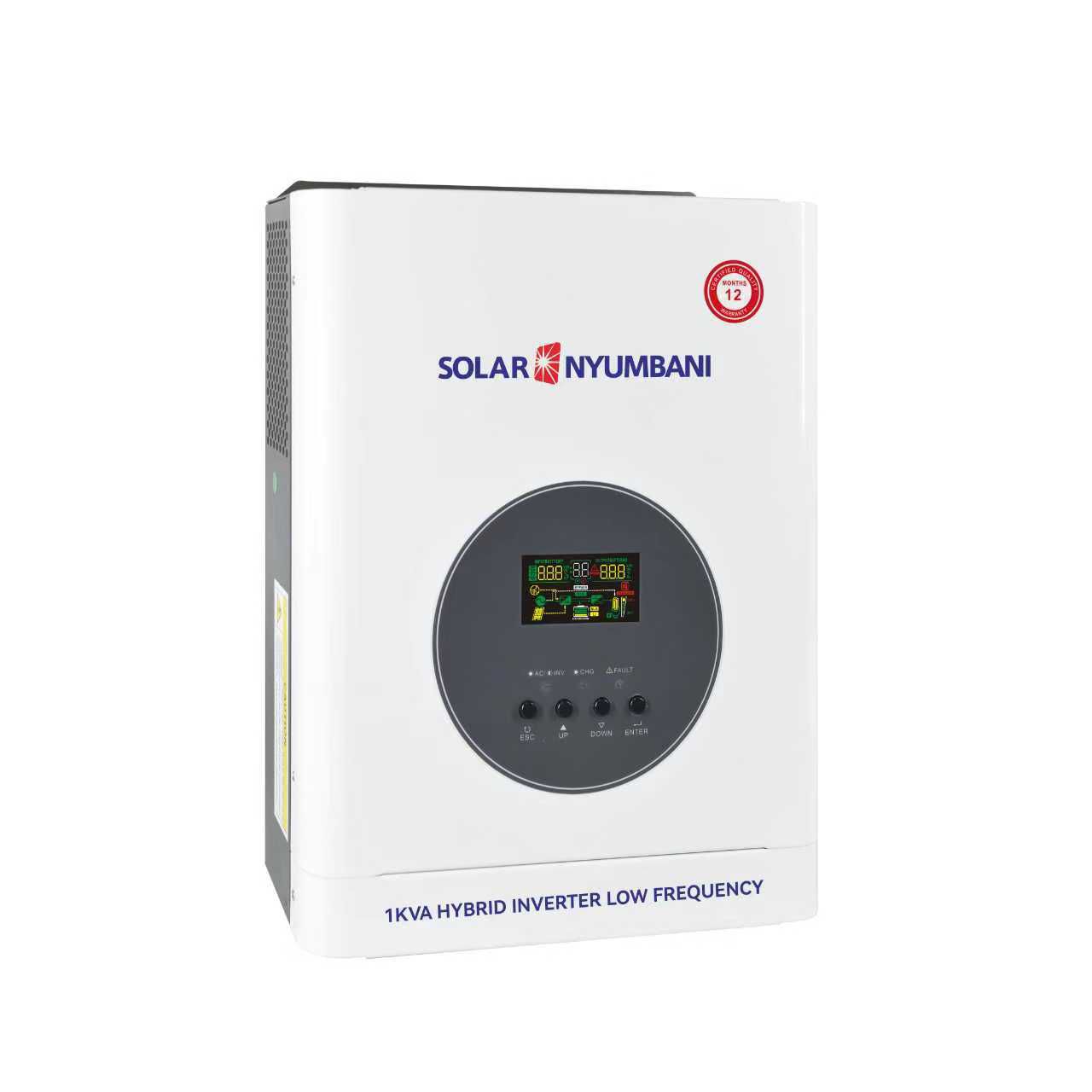
A 12V bank needs a 12V inverter; a 24V bank needs a 24V inverter. Never connect a 12V inverter to a 24V bank. For a small home, the Nyumbani 1KVA Solar Hybrid Inverter is a hybrid unit that takes solar, grid and battery input for basic appliances such as lights, a TV and fans. For a larger 24V bank, the Must Hybrid Solar Power Inverter 3KVA 24V VHM MPPT 80A combines a 3KVA inverter with an 80A MPPT charger. Whatever size you pick, it should be slightly above the total watts you expect to run at once.
Step 2: Use an MPPT controller
An MPPT charge controller tracks the panel's best working point and converts the extra voltage into charging current. This usually gives noticeably more charging in cloudy or hot conditions than a cheap PWM controller, which simply throws away surplus voltage. On a Kenyan rooftop, that difference matters.
Step 3: Match panels to your bank size
A simple rule: roughly 10 to 20 amps of charging current for every 100Ah of battery capacity. Charging current in amps is roughly panels watts divided by bank voltage. So for a 24V, 200Ah bank:
| Item | Figure |
|---|---|
| Bank capacity | 200Ah at 24V |
| Target charge current | 20 to 40A (10–20%) |
| Panel watts needed | about 480W to 960W |
| Example panels | 3 to 4 × 270W Golden Solar Bifacial Solar Panel |
Too little panel and the bank never fully recharges; too much and a small controller can overcharge it. Set the controller to the battery maker's absorption and float voltages, and check it again after a few weeks.
Wiring Batteries Safely: Series, Parallel and Series-Parallel Banks
How you connect batteries sets the bank’s voltage and capacity. Get it wrong and you can damage batteries or create a fire risk.
Series: add voltage, keep capacity
Join batteries positive-to-negative in a chain. Two 12V 100Ah batteries in series make a 24V 100Ah bank. The inverter must accept that voltage.
Parallel: add capacity, keep voltage
Join all positives together and all negatives together. Two 12V 100Ah batteries in parallel make 12V 200Ah. Use thick, equal-length cables so each battery shares the load.
Series-parallel: more of both
Four 12V 100Ah batteries: make two series pairs (24V 100Ah each), then parallel the pairs for 24V 200Ah. Keep pairs matched in age and type.
Cables and fuses: size cables for the highest current. A 2,000W load at 24V draws about 83A; use cable rated above that and a fuse near the battery positive. Short, thick cables reduce losses.
Balancing: keep cable lengths equal and tighten terminals firmly; check them after a week. Never mix old and new batteries, or different types and sizes, in one bank—the weaker battery drags the whole bank down and fails early.
If your inverter is 12V only, you cannot use a 24V series bank. Plan the bank voltage before you buy.
Installation Basics: Placement, Ventilation, Cables and Protection
Good installation is mostly common sense. Put the batteries somewhere cool, dry and out of reach of children and animals, keep the air moving, and use thick, short, well-tightened cables with a fuse near the battery. That alone prevents many early failures.
Placement and keeping the bank cool
Choose a shaded, dry spot: a locked metal cabinet, a dedicated battery room or a sturdy shelf in a store. Never put flooded batteries directly on a concrete floor, and keep them off the ground where damp can creep in. Raise them on a wooden or plastic stand.
Heat is the biggest silent killer. A battery kept at 35°C ages much faster than one at 25°C. Keep the bank out of afternoon sun, away from cookers, welding sets and inverter exhaust fans, and above the flood line.
Ventilation and safety around the bank
- Flooded and gel batteries can give off hydrogen gas while charging. Put them in a ventilated area, not a sealed cupboard. Low vents at floor level and high vents near the ceiling are ideal, since hydrogen rises.
- Keep sparks and flames away, and never smoke near the bank.
- Mount an ABC fire extinguisher nearby and keep a clean cloth and gloves for any acid spills.
Cables, torque and protection
Use short, equal-length cables between batteries so they charge and discharge evenly. Loose terminals cause heat and voltage drop: tighten them firmly and check them every few months. Fit a fuse or DC breaker on the positive cable close to the battery, sized to the cable, not the load.
For a 24V bank of 150Ah deep cycle batteries using 25mm² cable, a 100A DC breaker on the positive line protects the cable during a short. Earth the battery negative and metal cabinet according to your installer’s advice. These basics are cheap and prevent most installation accidents.
What a Battery Bank Costs in Kenya and How Long It Takes to Pay Back
Budgeting for a battery bank means looking beyond the battery itself. Cables, fuses, a sturdy shelf and a few tools add roughly 15–25% to the battery price. The table below gives typical Kenyan price ranges in mid‑2024 for a 12V bank with about 5kWh of usable energy (enough for lights, TV, fridge and phone charging for a day). Treat these as guides; shop around.
| Battery type | Usable energy | Typical price range (KES) | Extras (cables, fuses, mounting) |
|---|---|---|---|
| Lead‑acid (flooded) | ~5kWh | 40,000 – 55,000 | 8,000 – 12,000 |
| Gel | ~5kWh | 55,000 – 70,000 | 8,000 – 12,000 |
| Lithium (LiFePO4) | ~5kWh | 70,000 – 95,000 | 8,000 – 12,000 |
Lithium costs more upfront but lasts two to three times as many cycles as lead‑acid, so its cost per usable kilowatt‑hour over its life can be lower. Budget also for a charger or inverter with a suitable charging profile – many people already have one from a solar kit.
How to work out a simple payback
Start with your monthly KPLC bill or generator fuel spend. If you spend KES 3,000 a month on electricity for the loads the battery will support, that is KES 36,000 a year. A lead‑acid bank costing KES 50,000 (including extras) takes about 1.4 years to pay back, but may need replacing after 3–5 years. A lithium bank at KES 85,000 takes about 2.4 years and may last 8–10 years, so over a decade it often works out cheaper.
Include replacement cycles in your sums. For a fair comparison, divide total cost by expected years of service to get an annual cost.
For small backup needs, a ready‑made kit such as 100W Solar Home Lighting Kit bundles battery, panel and inverter for a single upfront price.
Maintenance: Making Your Bank Last for Years
A battery bank is the most expensive part of most solar systems, and in Kenya's heat even a good bank ages quietly. Ten minutes a month catches small problems before they cost you a battery.
Flooded lead-acid: water and terminals
Check water monthly, more often in hot months. Top up with distilled or deionised water only, just enough to cover the plates — never above the maximum line, and never with borehole or tap water. Keep terminals clean and tight; a loose or corroded terminal wastes power and can overheat. A light smear of petroleum jelly slows corrosion, and wiping dust off the tops stops damp dust tracking current between terminals.
Sealed gel and maintenance-free batteries
You cannot add water, so focus on cleanliness, tight terminals and correct charging. Keep the top dry and clean, and check that charger or inverter settings match the battery type. If a sealed battery feels hot or bulges, stop charging and have it checked.
Lithium (LiFePO4): settings and firmware
Lithium needs little physical care, but check charge settings periodically — charge and discharge limits should match the battery's specification. Where monitoring exists (USB, RS485 or optional WIFI), use it to watch state of charge and error codes. Keep firmware and settings current and keep the battery out of direct sun. The 12V 150Ah/10Hr Deep Cycle Solar Battery is low-maintenance, so checks are mostly settings and clean, tight connections.
Seasonal habits for Kenyan conditions
- Hot season: shade and ventilate the bank; heat shortens life faster than anything else.
- Long rains: panels may not fully recharge the bank, so cut evening loads or let a backup charger finish the job.
- Dusty spells: clean panel glass and inspect cable glands for moisture.
Safety and the Common Mistakes That Kill Battery Banks
A battery bank holds real energy and acid, so safety comes first. Flooded lead-acid batteries release hydrogen gas while charging — a spark can ignite it. Wear gloves and eye protection when handling acid, and keep baking soda nearby to neutralise spills. Never lay tools on top of a battery; a dropped spanner across terminals can arc and cause burns. Remove rings and watches before touching terminals. Ventilate the battery room with high and low vents — never charge in a sealed cupboard.
Over-discharge and overcharge
Both quietly kill batteries. Discharging lead-acid below about 50% shortens its life; going flat can ruin it in one session. Overcharging boils off water and warps plates. A good charge controller and inverter with a low-voltage cut-off prevent both. Set the cut-off to around 11.5V for a 12V bank (about 23V for 24V) and never rely on the inverter’s alarm alone.
Five recurring Kenyan mistakes and fixes
- Undersized cables: thin cables overheat and waste power. For a 12V bank carrying 100A, use at least 35mm² copper for short runs, and keep cables as short as practical.
- Mismatched batteries: mixing old and new, or different sizes and ages, causes the weak cell to drag the rest down. Replace the whole bank together.
- Deep discharges: running the bank flat costs cycles. Size the bank so daily use stays within about 50% for lead-acid (80% for lithium), and switch off heavy loads early.
- Poor ventilation: a sealed box traps hydrogen and heat. Fit vents top and bottom, and keep the bank out of direct sun.
- No fusing: a short in an unfused cable can start a fire. Fit a fuse or breaker on the positive cable close to the battery, sized to the cable, not the load.
For a small 12V system, a 300W inverter with built-in protections is a sensible start, but it will not run a pump or kettle. Match the inverter to your real loads and always fuse the battery connection.
Frequently asked questions
How many batteries do I need for a fridge and a few lights in Kenya?
It depends on the fridge, but a typical energy-efficient fridge plus a few LED lights and phone charging might use about 1.5 to 2.5 kWh a day. At 24V with one day of autonomy and 50% depth of discharge on lead-acid, that points to roughly 250 to 400Ah of lead-acid capacity, or a smaller lithium bank because more of its capacity is usable.
Can I mix old and new batteries in the same bank?
You can wire them together, but you should not. The older, weaker battery drags the whole bank down, charges unevenly and can cause the new battery to fail early. If one battery in a series string has failed, replace the whole string or keep the old batteries as a separate, smaller bank.
Is lithium worth the higher price in Kenya?
Often yes, especially in hot places and where the bank is cycled daily. Lithium gives more usable capacity, tolerates heat and deeper discharges better, and lasts more cycles, so the cost per usable kWh over its life can be lower than lead-acid. Lead-acid still makes sense for low-budget setups and occasional backup use.
Can I add more solar panels later without changing the battery bank?
Yes, as long as your charge controller can handle the extra current or you add a second controller, and the bank is large enough to absorb the charge safely. A rough guide is 10 to 20 amps of charging current per 100Ah of lead-acid capacity; too much panel on a small bank shortens its life.
How do I know when my battery bank needs replacing?
Watch for falling runtime, faster voltage drop under load, batteries that get hot or bubble excessively while charging, and a specific gravity or resting voltage that stays low after a full charge. In a series string, measure each battery; one weak battery usually means the string is near the end of its life.
Products in this guide
- 100ah solarmax battery
- Solarmax 12.8V 100Ah Lithium LiFePO4 Solar Battery
- 12V 150Ah/10Hr Deep Cycle Solar Battery
- Nyumbani 1KVA Solar Hybrid Inverter
- Must Hybrid Solar Power Inverter 3KVA 24V VHM MPPT 80A
- 270W Golden Solar Bifacial Solar Panel
Prices and stock change often; open each product for today's price.

Author
Solar Africa
Related posts